

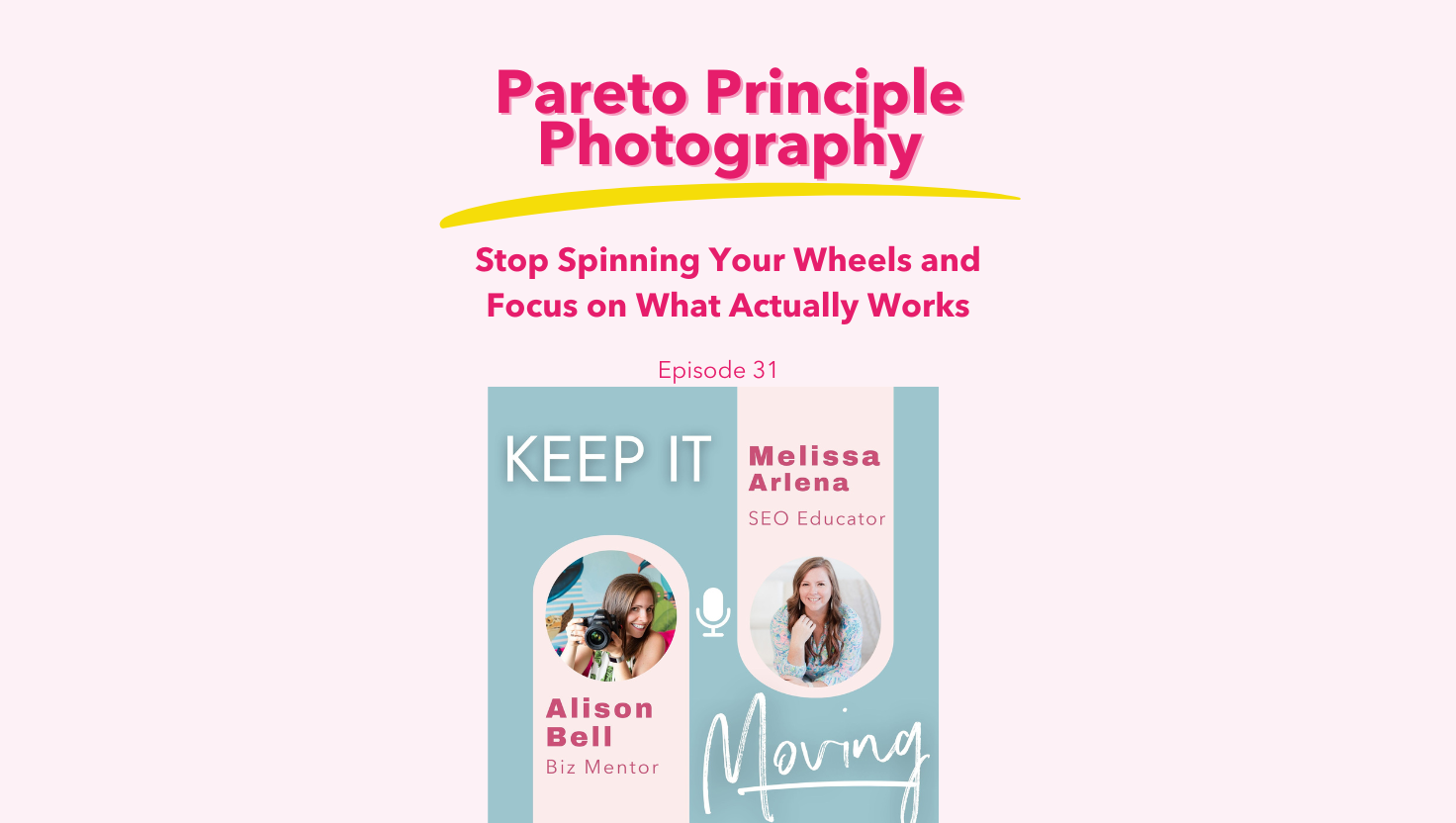

How to Use the Pareto Principle Photography Strategy to Book More Clients With Less Effort
Here’s a truth bomb: you’re probably wasting effort on things that aren’t moving the needle in your photography business.
The Pareto principle photography strategy can change everything. Also known as the 80/20 rule, the Pareto principle helps you identify which small percentage of your efforts is generating the majority of your bookings and revenue.
I see it all the time:
- Photographers grinding away on Instagram but never booking from it
- Optimizing every single page on their website (including the contact page, girl)
- Trying to be everywhere at once — and wondering why they’re exhausted but not booking more clients
Sound familiar? That’s where Pareto principle photography comes in.
On this week’s episode of the Get Booked Photography Podcast, Melissa and I unpacked the Pareto principle photography strategy — and how it can completely shift the way you run your business.
This isn’t about working harder. It’s about working smarter by focusing your energy on the small percentage of efforts that are actually bringing in results.
If you’ve ever felt like you’re doing all the things but not seeing the payoff, applying Pareto principle photography to your business is the answer.
Table of Contents
Listen to the Podcast
Listen to the Get Booked Photography Podcast (Previously Keep It Moving) Whether you’re refining or completely relocating your photography business, this show is for you! We cover all the major topics from money, to relocating, marketing and more. Subscribe now on Apple Podcasts or Spotify.
Want the notes in writing? Get the Next Steps Notes straight to your inbox by clicking here.
What Pareto Principle Photography Actually Means (and Why It Matters)
Pareto principle photography — also called the 80/20 rule — comes from an Italian economist named Vilfredo Pareto. He noticed that 80% of Italy’s land was owned by just 20% of the population. Wild, right?
Since then, this rule has been applied to everything from business to productivity to time management.
Here’s the gist: there’s a huge imbalance between input and output.
It might not always be exactly 80/20. Sometimes it’s:
- 70/30
- 90/10
- 50/40
But the pattern holds: a small fraction of your efforts is generating the majority of your results.
That’s the core of Pareto principle photography — and why it’s so powerful for photographers.
When you apply Pareto principle photography to your business, it shows up everywhere:
- 80% of your revenue comes from 20% of your clients (hello, repeat clients and memberships)
- 80% of your bookings come from 20% of your marketing efforts
- 80% of your website traffic comes from 20% of your blog posts
When you understand where your results are actually coming from, you can stop spreading yourself thin. You can start doubling down on what works.
According to Forbes Business Council, successful entrepreneurs use Pareto principle photography strategies to identify high-impact activities that drive growth.reneurs use the photography 80-20 rule to identify high-impact activities that drive growth.
Where Your Clients Are Really Coming From (Spoiler: It’s Probably Not Where You Think)
Let’s talk inquiry sources — because this is where Pareto principle photography gets really interesting.
Melissa and I both use Tave as our CRM. Other options include:
- Dubsado
- HoneyBook
- 17 Hats
- Session Now (which is doing way more than just mini sessions now)
The beauty of a good CRM is that it tracks where every single inquiry comes from. It shows who converts and what they spend.
Here’s what Melissa discovered when she dug into her numbers:
- On the photography side: SEO brings in the bulk of her inquiries
- On the SEO coaching side: Referrals from specific Facebook groups consistently convert at the highest rates
- That data told her exactly where to show up and engage — not everywhere, just the places that were actually bringing in clients who booked
That’s Pareto principle photography in action — identifying which 20% of her marketing channels were producing 80% of her results.
For me, it’s been eye-opening to look at my traffic acquisition in Google Analytics.
I was putting so much energy into Instagram — and the numbers didn’t lie. My organic search traffic was at least three times higher than social.
That’s when I decided to stop forcing it.
If Instagram isn’t booking clients for you, stop treating it like a priority. If SEO is bringing in inquiries but you’re ignoring it, lean in harder there.
Your business isn’t everyone else’s business. Pareto principle photography helps you figure out what’s working for you — not what works for someone else.

The “Wild Card”
That’s what he said. “The good news is you’re doing everything right. The bad news is you’re already doing everything. You’re a bit of a wild card.”
I’ve relaunched my photography business 7 times. From being all-inclusive photographer charging just $150 to running a six-figure business where clients happily invest thousands per session, I’ve experience the full spectrum of this industry – all on my own.
Now I’m help other photographers move faster, and make more – more money, more clients, more freedom. Book a Free 15 now!
Stop Optimizing Everything — Focus on What’s Actually Working
Here’s where photographers get stuck: they think they need to optimize everything when they move or relaunch.
You don’t.
If you’re relocating and staring at a website full of content that needs updating, pause.
Pareto principle photography applies here too. Before you go changing every single blog post, location tag, and portfolio description, open your Google Search Console.
Ask yourself:
- Which pages are actually getting clicks right now?
- Which blog posts are driving traffic?
- What content is already working?
Focus on those first. That 20% of content is what’s moving the needle.
This is Pareto principle photography at work — update it, optimize it for your new location, and let the rest sit for now.
Same goes for your website pages:
- Your homepage? Absolutely needs SEO love.
- Your portfolio landing pages? Yes.
- Your about page? Maybe.
- Your contact page? Girl, no. It’s fine. Leave it alone.
When it comes to content creation, ask:
What are the 20% of my clients producing 80% of my income? Then create content for them.
This is Pareto principle photography applied to your content strategy.
For Melissa, it’s newborns and memberships — so her content revolves around that. For me right now, it’s families, not newborns.
So I’m not wasting time creating newborn content that nobody’s clicking on. That’s Pareto principle photography in action.
This is also where Google Search Console becomes your best friend.
Look at what’s already getting clicks:
- If you wrote a post about local doulas and it’s bringing traffic, write more content like that
- Maybe midwives
- Maybe postpartum resources
- Maybe local family-friendly restaurants
I have a post about restaurants in Virginia Beach that I wrote two and a half years ago. It’s gotten 1,200 clicks in the last three months.
That reminded me I need to do the same thing for Oahu — date night spots, brunch places, quick bites in Kailua.
Use your past data to inform your current strategy. Pareto principle photography means focusing on what’s already proven to work.
The Numbers That Actually Matter (And How to Find Them)
Let’s make this super practical. To apply Pareto principle photography effectively, you need to know your numbers. Here’s where to look:
Google Search Console
This shows you which blog posts and pages are getting clicks. It’s gold for figuring out:
- What content to prioritize
- What’s working in your current location
- What needs updating if you’re moving
Google Analytics (Traffic Acquisition)
Go to the sidebar, click Acquisition, then Traffic. This chart will show you exactly how people are finding you:
- Organic search
- Direct traffic
- Organic social
- Referral traffic
It’s ranked from highest to lowest. This is the chart that convinced me to quit obsessing over Instagram. The numbers were clear.
When you use Pareto principle photography to analyze this data, you’ll stop wasting time on platforms that aren’t bringing results.
Your CRM (Tave, Dubsado, HoneyBook, etc.)
Look at your leads by source and you’ll see:
- Which inquiry sources are converting
- The average client spend per source
- Where your best clients are actually coming from
Sometimes referrals convert at 100%, but the volume is small. Sometimes SEO brings in a ton of inquiries, but the conversion rate is lower.
Both matter. You need to know where your best clients are coming from — not just the most inquiries. That’s what Pareto principle photography teaches you.
Entrepreneur Magazine emphasizes that data-driven decisions are what separate thriving businesses from struggling ones.
If you don’t have a CRM yet:
At minimum, ask every client: “Where did you find me?”
Track it in a spreadsheet. It doesn’t have to be fancy. Just start collecting the data so you can apply Pareto principle photography and see patterns emerge.
And here’s the thing: your numbers might surprise you.
Maybe you’re convinced Instagram is your bread and butter — but your CRM says otherwise. Maybe you think SEO doesn’t work in your small town — but it’s quietly bringing in inquiries while you sleep.
Pareto principle photography only works if you actually know your numbers.

You’re Not Spinning Your Wheels Anymore — You’re Building Smarter
Here’s the bottom line: Pareto principle photography means you don’t have to do everything.
You don’t have to:
- Be on every platform
- Optimize every page
- Create content for every service you offer
That’s exhausting, and it’s not moving your business forward.
Instead, use Pareto principle photography to focus on the 20% that’s giving you 80% of your results.
Here’s how to apply Pareto principle photography starting today:
- Find out where your best clients are coming from
- Double down on the marketing that’s actually working
- Create content for the clients who are spending the most with you
This is how you build a business that doesn’t drain you — one that works with you, not against you. Pareto principle photography gives you permission to stop doing the things that aren’t working.g.photography 80-20 rule gives you permission to stop doing the things that aren’t working.
Ready to stop spinning and start moving forward?
Here’s what to do next:
- Grab my free guide: 39 Ways to Get New Clients — it’s full of strategies you can test to see what works for your business
- Follow me on Instagram @alisonbellphotog for daily tips on growing your photography business
- Ready to dig into your numbers and build a strategy for your next move? Book a free discovery call and we’ll figure out what your 20% is
You’ve got this. Let’s Get Booked!
More Resources for Photographers
- Instagram Reels Photography Content: The B-Roll Bank That Saves You When Life Gets Busy

- Photography Blog Ideas: The 3 Types of Posts Every Photographer Needs

- Photography Website Homepage Ideas: What Your Homepage Actually Needs to Rank AND Book
- How to Work From Home With Kids — And Actually Get Things Done

- The 5 Photographer SEO Mistakes Sabotaging Your Website (And How to Fix Them Today)

- How to Price Photography: The Strategy That Stops Clients From Running



I'm a USMC spouse, South Carolina native, recovering homeschool mama of a 4 boy circus. They've taught me the most important facet of family photography: KEEP IT FUN!
Alison's Process
contact Alison